1. Have an Allergy Safety Policy
Your school needs a written allergy safety policy. It must be reviewed at least once every year, communicated appropriately and published on the school website.


First, a useful clarification: “Benedict's Law” is the commonly used name for the new school allergy safety measures. The legal duties sit within the Children's Wellbeing and Schools Act 2026, supported by the Department for Education's statutory Allergy Safety in Schools guidance.
From 1 September 2026, relevant schools in England must have an allergy safety policy, review it at least annually, make it known within the school and to parents, and publish it on the school's website. Schools must have particular regard to the Department for Education's statutory allergy guidance.
The guidance is designed to make allergy management more consistent: identifying pupils at risk, planning for emergencies, training staff, maintaining appropriate records and learning from serious incidents and near misses.
Your school needs a written allergy safety policy. It must be reviewed at least once every year, communicated appropriately and published on the school website.
Allergy awareness should form part of the school's arrangements, including recognising symptoms, knowing the emergency response and understanding the use of adrenaline auto-injectors where relevant.
Schools should identify pupils with allergies and ensure appropriate individual arrangements are in place, including Individual Healthcare Plans where required.
Schools need appropriate processes for recording serious allergic incidents and near misses, reviewing what happened and learning from them.
The requirements go beyond buying an emergency kit. Use this as a starting checklist and refer to the official DfE guidance for the detail that applies to your setting.
Use the DfE policy template as a starting point, adapt it to your school and make sure the finished policy is published and communicated.
Make sure allergy information is current and that pupils who need individual arrangements have appropriate plans in place.
Staff need to know how to recognise an allergic reaction, what action to take and where emergency medication is located.
Check what prescribed AAIs pupils carry or have available and review the school's arrangements for spare emergency AAIs in line with current government guidance.
Emergency medication needs to be accessible when required. Put a process in place to check stock, storage and expiry dates.
Make sure there is a clear way to record, review and learn from serious allergic incidents and near misses.
Your allergy arrangements should consider the wider school environment. The DfE guidance also recommends considering how staff and visitors with allergies are identified and supported.
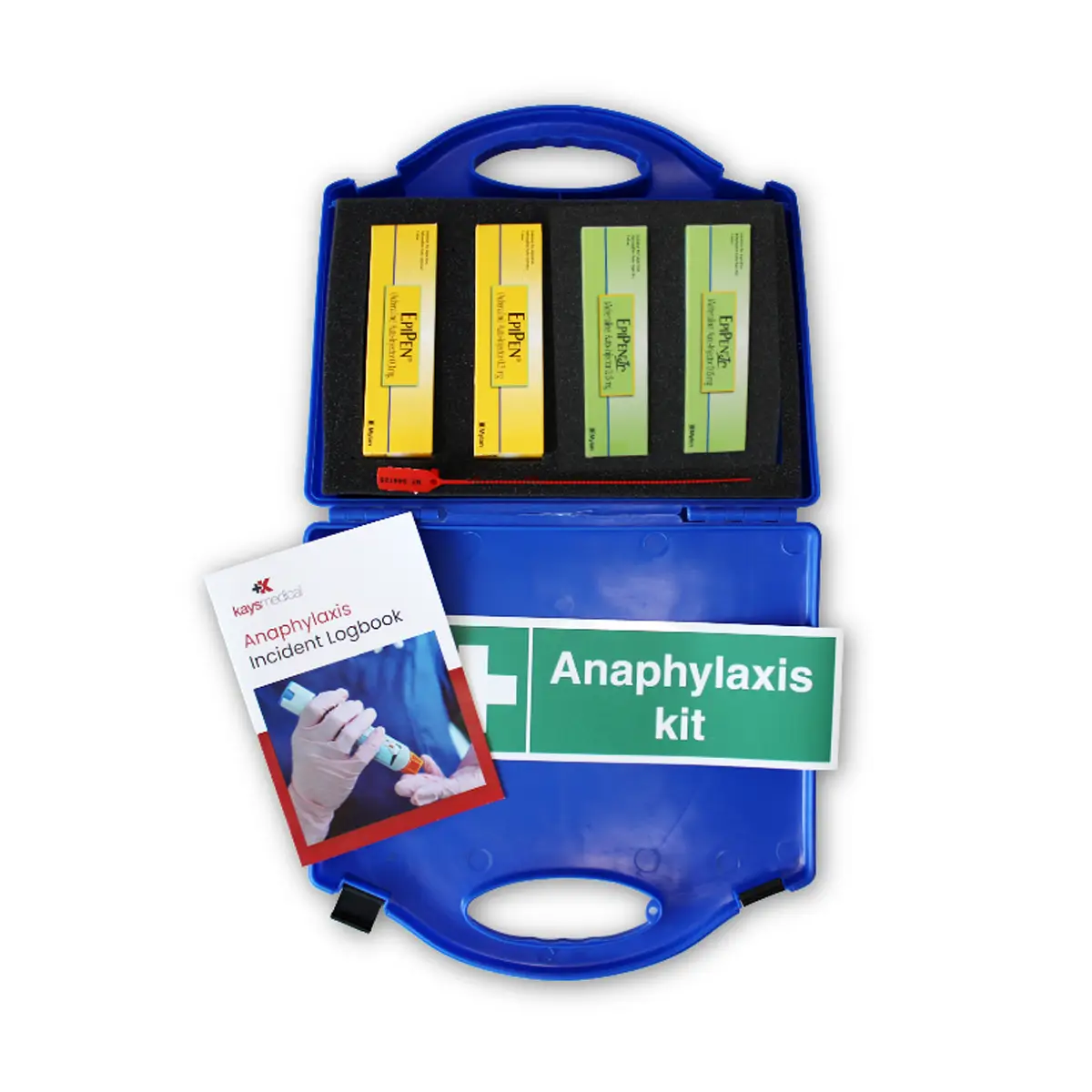
School Supplier has partnered with Kays Medical so schools can request appropriate emergency anaphylaxis supplies through a specialist medical supplier.
Kays All-in-One Kit: £395 annual subscriptionImportant: School Supplier does not hold or distribute the medication. Your request is completed through Kays Medical's secure form and the medical products are supplied directly by Kays Medical to the school.
The Kays request form lets schools choose Junior, Adult or a mixed anaphylaxis kit. The terminology can understandably cause confusion in a primary-school setting.
Current government guidance uses the 150 microgram AAI category for children under 6 years of age.
For school emergency stock, current government guidance uses the 300 microgram category for individuals over 6 years of age. This is why a child of primary-school age may fall within the option described as “Adult” on the order form.
Government guidance indicates that a typical primary school should obtain two 150 microgram spare devices and two 300 microgram spare devices. A secondary school would normally require 300 microgram devices, with consideration given to having two pairs where needed so emergency devices are not too far away. Special schools should consider the age profile and needs of their pupils.
Do not use this page to make an individual pupil's prescribing decision. Schools should follow current government guidance, pupils' healthcare plans and appropriate medical advice.
The Kays form also gives your school the option to request salbutamol inhalers. These are emergency reliever inhalers for asthma and are separate from the new allergy safety requirements.
Schools have been permitted to hold emergency salbutamol inhalers for a number of years. They can be used, in accordance with the relevant guidance and school arrangements, for a pupil with asthma or a pupil who has been prescribed reliever medication when their own inhaler is unavailable. You do not need to add salbutamol inhalers simply because you are requesting an anaphylaxis kit.
The button below opens a dedicated Kays Medical request form in a new window. It only takes a few minutes, but having the following information ready will make the process straightforward.
Enter the school name, school address and local authority. Medical supplies requested through this route can only be delivered to the named school.
Select the anaphylaxis kit required: Adult/300mcg, Junior/150mcg or a mixed option. You can also request emergency salbutamol inhalers if your school requires them.
Complete the authorised request details and use an official school email address. You will also confirm that the supplies are for the school named in the request.
The medicines supply rules require the appropriate authorised request. The Kays form will ask for the details of the headteacher/principal or doctor completing the request. Please ensure the person completing the form is authorised to do so and that an official school email address is used.
This is deliberate. Prescription-only medical products require specialist handling and supply arrangements. School Supplier/CDUK does not stock or distribute these medicines. We have partnered with Kays Medical so the request, authorisation, invoicing and supply are handled directly by the specialist medical supplier.
Once your request has been processed, Kays Medical will invoice the school directly. Following payment, the order can then be dispatched directly to the school.
The secure form opens on Kays Medical's Microsoft Forms service. School Supplier may receive a referral commission on kits supplied through this dedicated CDUK route; this does not change the price charged to the school.
This page is intended to make the requirements easier to understand, but schools should use the current official guidance when setting their policies and procedures.
Department for Education - Allergy Safety in Schools statutory guidance
Children's Wellbeing and Schools Act 2026 - Section 34
Government guidance on emergency adrenaline auto-injectors in schools
Government guidance on emergency salbutamol inhalers in schools
Important: This page is general information for schools in England and is not medical or legal advice. Requirements can vary by school type and individual circumstances. Always refer to current Department for Education, Department of Health and Social Care and MHRA guidance, and seek appropriate professional advice where required. Product availability, pricing and supply are subject to Kays Medical's terms and processes.